› Welcome
This is a collaborative specialization dossier created by Iliana Carlos, Ariana Vargas, and Lewis Vidaña. Our project focuses on community-based digital archival work and the particular ways in which organizations outside of mainstream memory institutions maintain their technological infrastructures. To explore this, we interviewed Sam Sermerño (they/she), a digital archivist at the OUTWORDS Archive, an oral history project and digital archive dedicated to capturing, preserving, and sharing the stories of LGBTQIA2S+ elders, "to build community and catalyze social change." Sam Sermeño joined OUTWORDS in 2022 and is a first generation librarian, archivist, educator, and creative. They were inspired to enter into the field of community archives after seeing the scholarship around the oral history project for ACT UP, the AIDS Coalition to Unleash Power. Their work centers a love for People’s History, LGBTQIA+ communities, oral histories, community archives, decolonial-liberation movements, and cultural preservation.
In this dossier, we will cover a range of topics related to the field of community archives with information taken directly from our interview with Sam. They had much wisdom to shed on the responsibilities, challenges, and opportunities in community archive work. In this section of the website, you will find information about the ecological landscape of community archives, specifically queer community archives, and job/labor trends within it. In our interview section, you will find information about Sam’s specific role at OUTWORDS, including typical tasks, skills needed, and political challenges. In our beyond OUTWORDS section, you will find links to job resources and a list of 5 resources to help you better understand the profession and field. Lastly, the OUTWORDS tab will link you to their website, so that you can explore their materials for yourself.
We are incredibly grateful to Sam Sermeño for their time in meeting with us and the knowledge that they imparted. We hope that it helps other people who are hoping to pursue a career in the growing field of community archives!
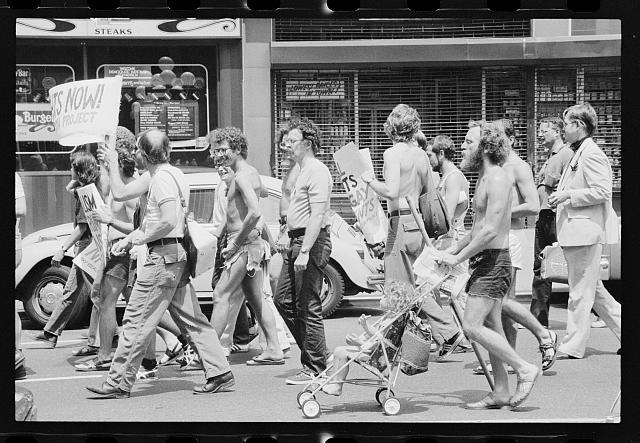 Leffler, Warren K, photographer. Gay rights demonstration at the Democratic National Convention, New York City. New York, 1976. Photograph. https://www.loc.gov/item/2005696365/.
› The Wider Landscape of Queer Studies and Archives
A review of digital archivist job postings and descriptions reveals several commonalities, with many roles combining traditional archival responsibilities, such as cataloging, accession, and long-term preservation, with digital asset management and maintenance of digital infrastructures.
Some examples of journals and magazines within the field include Transgender Online, a peer-reviewed, multi-disciplinary journal dedicated to addressing healthcare issues of Transgender individuals, communities, and families, as well as The Gay & Lesbian Review, a bimonthly magazine of history, culture, and politics targeting an educated readership of LGBT people. Other notable collections are the Lesbian, Gay, Bisexual, and Transgender Studies Commons which offers free, curated, and full-text access to scholarly articles, dissertations, and book chapters that are provided by universities and colleges worldwide, and Independent Voices, a collection containing over 380,000 pages of independent alternative press from the 1960s-1980s that deals with LGBTQ+ issues and themes.
Examples of conferences attended within this specialization include the Creating Change conference, Invisible Histories / Queer History South (QHS), and the LGBTQ+ History Association CFP: Queer/Trans History conference under the Western History Association. Those interested in professional associations within the field of queer archival may find some success in "The Diverse Sexuality and Gender Section (DSGS)" of the Society of American Archivists, the section was founded in 1989 by those who were concerned about LGBTQIA+ history and the role of members of this community within the archival profession.
For a more consolidated list of LGBTQIA+ archives, libraries, and other similar resources, the Library of Congress offers a online list of research guides at here.
For job resources, a list of sites may be found within the extended information section of our site.
› Job-Market Outlook
Quotations have been lightly edited for clarity.
"I think the field itself is growing. I think the wider waves of professionals is growing too, and sometimes I personally feel like there's a big bottleneck.
While asserting the growth of the field and archival opportunities in the quote above, our interviewee Sam noted that due to "high career and life satisfaction...a lot of the older generations [of LIS professionals] tend to stay in their roles for like 40+ years," creating a "bottleneck" effect that may prevent the expansion of current teams. They expressed a desire for greater institutional support to aid young professionals or those entering the field. Sam also stressed the useful ability to recognize transferable skills you have and use them to market yourself, especially due to entry-level jobs requiring higher years of experience. However, growing opportunities in the digital sphere as archives moves away from solely physical spaces not only promote new job opportunities, but welcome new skills based upon this shifting landscape of technological innovation. For more information, please refer to our annotated bibliography as it contains a link to a toolkit by the Digital Preservation Coalition that educates archivists on basic steps and recommendations for digitizing collections. Sam further notes:
"I definitely think being able to recognize transferable skills and how you can...market or even see those skills applying in an art digitizing environment. Like that could also translate to maybe marketing and digital asset management. I think there's a lot of ways in which we're not just thinking about like, the physical stacks, right?
Example Job Descriptions
Digital Archivist - Clemson University
Digital Archivist - The Dallas Morning News
Archivist, Historian for Public Engagement and Research Services (Librarian I)
Director of LGBT Archives and Special Collections
Create LGBTQ Organization Catalog Intern
"What Does It Take to Be a Well-rounded Digital Archivist?" - blog post by Peter Chan (Stanford University)
› Training Agenda
To enter into this profession, one will find it useful to recognize transferable skills that you may have (not necessarily those exclusive to archival work) from previous educational and professional experiences. Considering both job postings and Sam's interview as a point of reference, while having an archival or history background is certainly a huge plus, strong skills in research, project design, time management and competent writing skills are both heavily encouraged and expected from applicants. To help with a lack of onsite experience, picking up internships at GLAM institutions is highly recommended as it offers the valuable opportunity of making networking connections.
In a formal academic environment such as an MLIS program, it may be useful to take courses focusing on digital asset management, digitization, and best practices for preserving born-digital materials. The Society of American Archivists also has a Digital Archives Specialist (DAS) Curriculum and Certificate Program, which may help those who are already in the field and interested in expanding their skillsets.
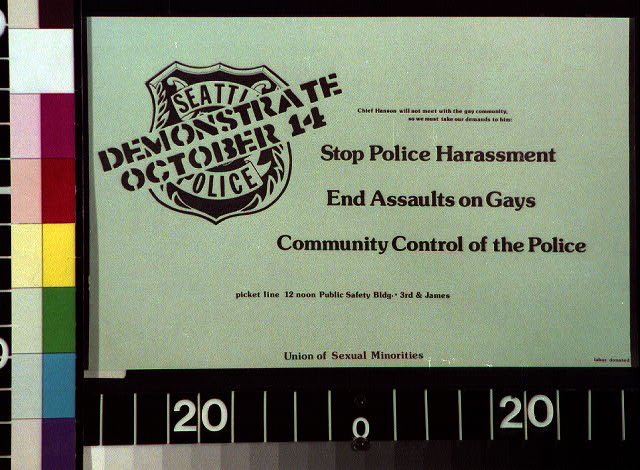 Union of Sexual Minorities, sponsor/advertiser. Chief Hanson will not meet with the gay community, so we must take our demands to him -- stop police harassment ... 1975. Print. https://www.loc.gov/pictures/item/2016648069/.
› Labor Trends
Coinciding with current societal trends and political pressures, Sam noted an increase of rampant homophobia and attacks on any ideology coded with Diversity Equity and Inclusion. Security risk for more public facing events was also a more prominent issue with two described experiences where presenters were not able to be publically named and, at another event, Sam wished to share a conference link to more staff but was unable to do so due to acts and threats of doxxing that has previously happened to organizers and others within the South.
There is also increased spatial awareness on learnt safety measures and advocacy work, one notable example being the roles that certain schools in the South play in order to support LGBTQIA students on campus with encouragement for archive and grant funding to change their language so that it will not overtly omit or use the word trans. Since the Outwords Archive is a private nonprofit that largely exists on grants, there is a commitment to prioritizing bipoc, trans, and gender non-conforming interviewees while curating language usage during this particularly turbulent political administration.
In an effort to decentralize the powers pressuring archival and queer studies, other structual changes such as centering queer voices and encouraging community agency in order to sustain a multilayered approach that leads to ethical stewardship, prioritizing transparency, and community-led consultation with active archival initiatives that opposing dominant government narratives. One example for this would be challenging existing heteronormative item descriptions to correct outdated and sexist language that obscures or/and objectifies queer identities Additionally, thinking of the long-term care of physical materials into the rapidly shifting digital age will further the foundational goal of sustained legacy in the face of institutional neglect. Sam noted:
"trying to figure out how to work with the skills that we have and to still use our values...has been important...a lot of emphasis on capacity building and trying not to expand too much of what we're doing until some of the tides change